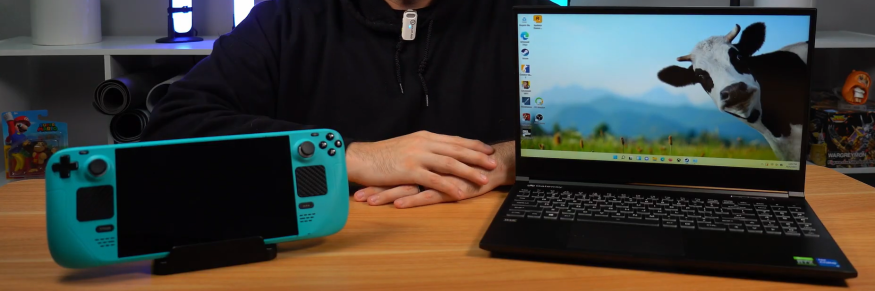
Portable PC gaming thrives on devices that deliver immersive play without tethering you to a desk. In the steam deck vs gaming laptop debate, the Steam DeckOLED carves a niche for effortless handheld action, while gaming laptops pack desktop muscle for on-the-go power users.
Steam Deck OLED: Handheld Powerhouse for Portable PC Gaming
The Steam Deck OLED redefines portable PC gaming with its sleek, controller-like form factor. Released as Valve's upgraded handheld, it sports a stunning 7.4-inch HDR OLED display at 90Hz, pumping out crisp 1280x800 visuals that pop during fast-paced titles. Weighing just 1.41 pounds, it fits snugly in one hand, perfect for couch sessions or commutes.
Key specs make it a standout:
- Processor: Custom AMD APU with Zen 2 CPU and RDNA 2 graphics for smooth 30-60 FPS at low-to-medium settings.
- Battery: Up to 8 hours on lighter games like "Hades II", down to 2 hours on heavy hitters like "Elden Ring"—far better than most rivals.
- Storage: Options from 512GB SSD to 1TB, expandable via microSD for massive libraries.
- OS Perks: SteamOS with Proton layers runs over 15,000 PC games, including emulation for retro gems.
Priced from $549, the Deck OLED shines for budget-conscious gamers chasing steam deck vs gaming laptop portability. Its trackpad controls mimic a mouse for strategy games, and desktop mode lets it dock to a TV or monitor like a mini PC. Over at iBUYPOWER's blog, they highlight how this setup crushes casual play without the bulk.
Real-world tests show it handling 2026 releases like "Starfield" expansions at playable frames, proving portable PC gaming doesn't mean settling for mobile trash. Upgrades like improved haptics and Wi-Fi 6E keep it competitive two years post-launch.
Gaming Laptops: Versatile Beasts in the Steam Deck vs Gaming Laptop Arena
Gaming laptops flex superior horsepower, turning any table into a battle station for portable PC gaming. Mid-range models like those with RTX 4060 GPUs and Intel Core Ultra 7 chips start around $1,000, boasting 15-17 inch screens at 144Hz or 240Hz for buttery gameplay.
Standout features include:
- Graphics Muscle: Dedicated NVIDIA or AMD GPUs push 1080p ultra settings with ray tracing at 60+ FPS in demanding AAA games.
- Multitasking: Windows 11 handles Steam, Epic, browsing, and even light editing—something the Deck struggles with outside gaming.
- Upgradability: Swap RAM, storage, or even GPUs in some chassis for future-proofing.
- Display Options: QLED or mini-LED panels with higher resolutions up to QHD, ideal for cinematic experiences.
These machines weigh 4-6 pounds and gulp power, with batteries lasting 1-2 hours on max settings. Cooling systems with vapor chambers prevent throttling during marathon sessions. A Reddit thread in r/SteamDeck echoes this, where users note laptops excel for work-play hybrids but lag in true mobility.
In benchmarks, they smoke the Deck on raw performance—think "Cyberpunk 2077" at high settings without tweaks. Peripherals like RGB keyboards and multiple ports add appeal for streamers or creators dipping into portable PC gaming.
Head-to-Head: Steam Deck vs Gaming Laptop Breakdown
Direct comparisons reveal clear winners per use case in portable PC gaming. The Deck prioritizes joy in tight spaces, while laptops demand setup but reward with depth.
Key differences break down like this:
- Price: Steam Deck OLED at $549-$649 beats gaming laptops at $1,000-$2,000—Deck takes the win.
- Battery Life: Deck's 2-8 hours crushes laptops' 1-2 hours during gaming—Deck wins.
- Weight/Portability: Deck's 1.41 lbs and pocketable design tops laptops' 4-6 lbs needing a bag—Deck ahead.
- Performance (FPS): Laptops hit 60+ at 1080p vs Deck's 30-60 at 720p—laptop wins.
- Screen Quality: Deck's 7.4" OLED at 90Hz ties with laptops' 15-17" 144Hz+ panels.
- Versatility: Laptops handle gaming plus productivity, outpacing Deck's gaming focus—laptop wins.
- Storage/Upgrades: Laptops offer expandable SSD/RAM over Deck's microSD and fixed internals—laptop edges out.
Portability tips the scale for Deck fans—imagine firing up "Baldur's Gate 3" mid-flight without lugging a charger. Laptops counter with broader compatibility, running non-Steam launchers flawlessly.
Battery face-offs favor the Deck heavily:
- Deck: 3-5 hours on indies, sustainable for daily commutes.
- Laptop: Plugs in for peak power, but unplugged play feels limited.
Performance edges go to laptops for 2026 titles optimized for high-end hardware. Yet, the Deck's efficiency shines in optimized Steam library, hitting parity in many scenarios via FSR upscaling.
Casual players rave about the Deck's ergonomics—no desk required. Power users on forums like Overclockers UK point out laptops' edge in VRAM-heavy games or 1440p streaming.
Battery and Portability: Real-World Portable PC Gaming Tests
Battery life defines steam deck vs gaming laptop viability for untethered play. The Deck OLED's larger cell and efficient APU deliver marathon sessions—8 hours on visual novels, 3 on "Forza Horizon 5". TechTimes articles from early 2026 back this, noting its lead in casual scenarios.
Laptops throttle to preserve juice, capping at 90 minutes on "God of War Ragnarok" before dimming screens or dropping frames. External batteries help, but add bulk, eroding portable PC gaming appeal.
Portability lists highlight extremes:
- Steam Deck Wins: One-handed play, silent operation, instant resume from sleep.
- Laptop Strengths: Full keyboard for MMOs, external monitor support out of the box.
- Shared Drawbacks: Both need tweaks for peak efficiency—Deck via power tools, laptops through undervolting.
Travel gamers report the Deck surviving 10-hour trips with multiple titles, while laptops shine at cafes with outlets. Heat management favors the Deck's fanless vibes under light loads.
Price and Value: Steam Deck vs Gaming Laptop Long-Term
Value hinges on needs. The Deck's $549 entry holds 70% resale after a year, per marketplace trends. Matching its APU in a laptop demands $1,200+ for equivalent efficiency.
Long-term ownership:
- Deck: Fixed hardware, but software updates extend life to 5+ years.
- Laptop: Upgrade cycles every 3 years, higher initial outlay.
- Total Cost: Deck under $700 with accessories; laptops hit $1,500 fully kitted.
Budget buyers snag the Deck for pure portable PC gaming joy. Pros investing in one machine pick laptops for dual-duty.
Best Picks for Your Portable PC Gaming Style
Travel light with the Steam Deck OLED if steam deck vs gaming laptop boils down to grab-and-go fun—its OLED glow and battery make every trip a LAN party. Opt for a gaming laptop like ASUS ROG or MSI models when versatility trumps size, powering through workdays and nights alike. Your playstyle decides the champ in this portable PC gaming showdown.
Frequently Asked Questions
1. Is Steam Deck OLED better than a gaming laptop for portable PC gaming?
No single winner—Steam Deck OLED excels in true portability and battery life (2-8 hours unplugged), ideal for casual couch or travel play. Gaming laptops dominate raw performance (60+ FPS at 1080p) but weigh more and need outlets after 1-2 hours.
2. Can the Steam Deck replace a gaming laptop?
For Steam library users, yes—it runs 95% of titles via Proton, docks for TV play, and handles emulation. It falls short for productivity, non-Steam games, or high-res editing where laptops' Windows versatility and upgrades shine.
3. Which has better battery life: Steam Deck or gaming laptop?
Steam Deck OLED leads with up to 8 hours on light games like "Hades II" and 2-3 hours on AAA, thanks to efficient TDP scaling. Laptops drop to 45-90 minutes at max settings, better for plugged-in sessions.